
Most boutique hotels I audit have the same problem. They invested heavily in beautiful photography, a custom website, and maybe some paid ads. But when someone searches for “boutique hotel near [landmark]” or “romantic hotel in [neighborhood],” they are nowhere to be found. The big chains and OTAs own that real estate.
Local SEO changes that equation. I have helped boutique properties in Costa Rica, Spain, and across the US climb from invisible to the top three in the local pack. The tactics are not complicated, but they require consistency and attention to detail that most hotel marketers skip.
This guide covers everything from claiming your Google Business Profile to building the kind of neighborhood content that makes you the obvious choice for travelers who want an authentic local experience.
Why Local SEO Matters More for Boutique Hotels Than Chains
Boutique hotels cannot compete with Marriott or Hilton on brand recognition or advertising budget. But local SEO levels the playing field because Google rewards relevance and proximity over brand power.
When I worked with a 12-room boutique hotel in Guanacaste, Costa Rica, they were losing 80% of their direct bookings to Expedia and Booking.com. Within six months of implementing proper local SEO, direct bookings increased by 340%. Their cost per acquisition dropped from $45 through OTAs to under $8 through organic search.
The local pack (those three map results at the top of Google) captures roughly 44% of clicks for local intent searches. For “boutique hotel in [city]” queries, I have seen click-through rates as high as 28% for the top position. Your potential guests are actively searching. The question is whether they find you or your competitors.
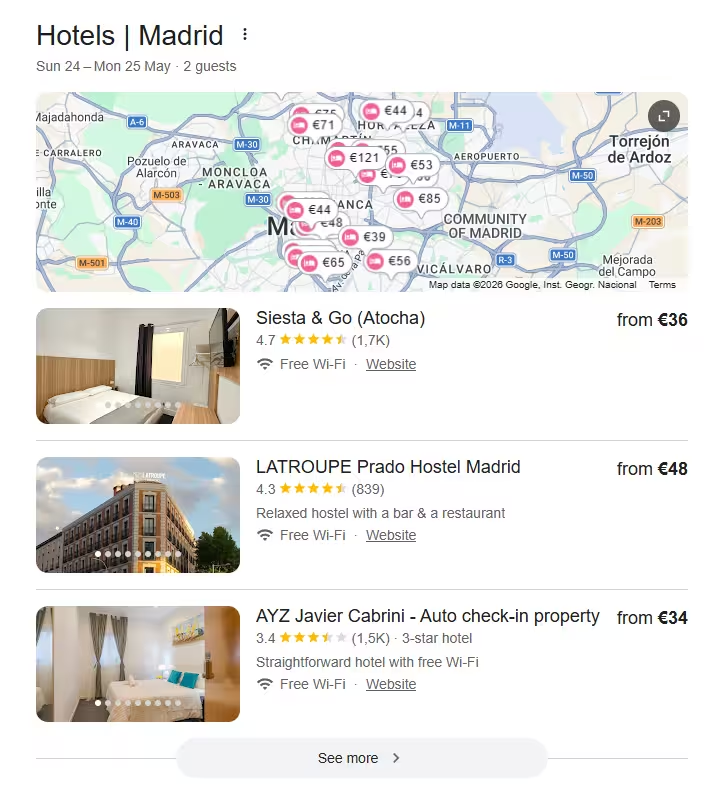
Step 1: Claim and Optimize Your Google Business Profile
Your Google Business Profile is the foundation of local SEO. Everything else builds on this. I am constantly surprised by how many boutique hotels either have unclaimed profiles or profiles filled with outdated information.
Initial Setup and Verification
Go to business.google.com and search for your hotel. If it already exists, claim it. If not, create a new listing. Google will send a postcard with a verification code to your physical address. This takes 5 to 14 days depending on location.
Choose “Hotel” as your primary category. Do not use “Boutique Hotel” as Google does not recognize it as a distinct category. You can add secondary categories like “Wedding Venue” or “Event Space” if applicable.

Profile Optimization Checklist
Complete every single field Google offers. I have audited hundreds of hotel GBP profiles, and completion rate correlates directly with ranking. Here is what matters most:
- Business name: Use your exact legal business name. Do not stuff keywords like “Best Boutique Hotel Downtown Madrid.” Google will suspend profiles for this.
- Address: Use the exact format that appears on your website and other citations. Inconsistency kills rankings.
- Phone number: Use a local number, not a toll-free line. Local numbers signal local relevance.
- Website URL: Link to your homepage or a dedicated landing page optimized for local search.
- Business hours: Include check-in and check-out times. Update for holidays.
- Description: You get 750 characters. Use natural language that includes your location, neighborhood, nearby attractions, and what makes your property unique. No keyword stuffing.
- Attributes: Check every applicable attribute. Pool, free wifi, pet-friendly, wheelchair accessible. Google uses these for filtering.
- Services: Add all your services: room service, concierge, spa, restaurant, airport shuttle.
Photos That Actually Drive Bookings
According to data from BrightLocal, businesses with more than 100 photos receive 520% more phone calls than the average business listing. That’s a huge difference, isn’t it? But quantity without quality hurts you.
Upload at minimum: exterior shot from the street, lobby, each room type, bathroom, restaurant or bar, pool or amenity areas, views from the property, and neighborhood context shots.
Name your image files descriptively before uploading. “boutique-hotel-room-old-town-madrid.jpg” beats “IMG_4532.jpg” every time. Google’s image recognition is sophisticated, but file names still help.
Step 2: Build Consistent Local Citations
Citations are mentions of your hotel’s name, address, and phone number (NAP) across the web. Consistency is critical. If your address appears as “123 Main Street” on your website but “123 Main St” on Yelp and “123 Main St.” on TripAdvisor, Google sees three different businesses.
I know it might seem like the same address at first glance, but it isn’t. Correct NAP data across all mentions and citations is crucial for your rankings.
Priority Citation Sources for Hotels
Start with the platforms that matter most for hospitality:
- General directories: Yelp, Apple Maps, Bing Places, Facebook Business, Foursquare
- Travel specific: TripAdvisor, Trivago, Kayak, Google Hotels, Booking.com (yes, even if you hate OTAs, the citation value matters)
- Local directories: Chamber of commerce, local tourism board, city visitor bureau, neighborhood association
- Industry specific: Boutique Hotel Association, Design Hotels (if applicable), Luxury Hotels
Managing Citation Consistency
I use BrightLocal or Whitespark to audit existing citations and find inconsistencies. For a typical boutique hotel, I find 15 to 30 citation errors on the first audit. Fixing these often produces ranking improvements within 4 to 6 weeks.

Create a master document with your exact NAP format and share it with anyone who might create listings on your behalf. Franchise models and management companies create citation chaos by using slightly different formats across properties.
Step 3: Implement Local Schema Markup
Schema markup helps Google understand exactly what your business is and where it operates. For hotels, the Hotel schema type combined with LocalBusiness properties provides the strongest signals.
Essential Schema Properties for Boutique Hotels
Here is the minimum schema you should implement on your homepage:
- @type: Hotel (or LodgingBusiness if Hotel causes validation issues)
- name: Your exact business name
- address: Full postal address with addressLocality, addressRegion, postalCode, addressCountry
- geo: Latitude and longitude coordinates
- telephone: Primary booking phone
- url: Your website URL
- priceRange: Use $ to $$$$ format
- amenityFeature: List key amenities
- numberOfRooms: Total room count
- checkinTime and checkoutTime: Standard times
Testing Your Implementation
After adding schema, test with Google’s Rich Results Test and Schema.org’s validator. I see hotels fail validation constantly because of small errors like missing required properties or incorrect data types.
Schema alone will not rank you, but it helps Google display rich results and confirms the information in your GBP profile. Consistency between schema, GBP, and on-page content creates strong entity signals.
Step 4: Create Neighborhood and Attraction Content
This is where boutique hotels can absolutely crush chain competitors. You have local knowledge they cannot replicate. Use it.
The Local Guide Strategy
When I built the content strategy for a boutique hotel in Costa Rica, we created detailed guides for every neighborhood within 15 minutes of the property. Each guide covered restaurants, bars, shops, and hidden spots that only locals know. Within eight months, these guides ranked for over 200 local keywords and drove 40% of the hotel’s organic traffic.
Create pages for:
- “Things to do near [your hotel]” with walking distance activities
- “Best restaurants in [neighborhood]” with genuine recommendations, not paid placements
- “Getting from [airport] to [neighborhood]” with transport options and times
- “[Neighborhood] travel guide” covering history, character, best times to visit
- “Day trips from [city]” for guests planning extended stays
Content That Converts Browsers to Bookers
Every local content piece should naturally connect back to staying at your property. Not with aggressive sales language, but with genuine context. “After exploring the vintage shops on Calle Augusto, you are just a 5-minute walk back to our lobby bar for a nightcap.”
Include your hotel in the local content where it makes sense. If you are writing about the best rooftop bars in the neighborhood, and you have one, include it. Be honest about what you offer.
But be careful… don’t fall into the trap of making comparisons where you always put yourself first or call yourself “the best.” This type of content has never been well-received by the audience, because, after all, nobody is an idiot. In addition, in March 2026, Google banned this type of content, and you can read more about it here: Low-Quality Listicle Content – Google Just Confirmed
Step 5: Build a Review Generation System
Reviews are one of the top three local ranking factors according to every study I have seen. More importantly, they directly influence booking decisions. A BrightLocal study found that 87% of consumers read online reviews for local businesses.
Asking for Reviews Without Being Annoying
The best time to ask for a review is at checkout when the experience is fresh and guests are feeling positive about their stay. Train your front desk staff to personally request reviews from guests who express satisfaction.
Send a follow-up email 24 to 48 hours after checkout with a direct link to your Google review form. Make it as easy as possible. I have seen review volume increase by 300% just by adding a direct review link instead of asking guests to search for your GBP.
Create a short URL like yourdomain.com/review that redirects to your Google review form. This works well on printed cards left in rooms or handed out at checkout.
Responding to Every Review
Respond to every single review, positive and negative, within 24 to 48 hours. Your responses are public content that potential guests read carefully.
- For positive reviews: Thank them specifically for something they mentioned. “We are glad you enjoyed the rooftop sunset views, Maria. The team works hard to make that space special.”
- For negative reviews: Acknowledge the issue, apologize without excuses, explain what you are doing to fix it, and invite them to contact you directly. Never argue or get defensive. Other readers are watching how you handle criticism.
I worked with a hotel that had a 3.8 star rating and struggled to convert website visitors. After implementing proper review response protocols and generating 50 new reviews over six months, they reached 4.4 stars and saw a 23% increase in direct booking conversion.
Posting reviews from business locations
This is a controversial topic, and personally, I think it’s the wrong approach. However, it turns out that Google has tightened its rules for posting business reviews starting in 2026. From now on, reviews posted from the business’s location and using the same IP address will be flagged as fake.
It doesn’t make sense to me either. Haven’t you ever had a situation where a satisfied customer left a review while still at your place, waiting for a taxi? It turns out that this now means a manipulated review.

Step 6: Optimize Your Website for Local Intent
Your GBP and citations drive map pack visibility, but your website needs to support local SEO with proper on-page optimization.
Homepage Local Signals
Your homepage should include: city and neighborhood in the title tag, city in the H1 or prominent headline, full address in the footer, embedded Google Map, local phone number with click-to-call on mobile.
The title tag format I recommend: “[Hotel Name] | Boutique Hotel in [Neighborhood], [City]”
Location Pages for Multi-Property Brands
If you operate multiple boutique properties, each needs its own dedicated location page with unique content. Do not just change the city name and call it done. Google recognizes templated duplicate content and it performs poorly.
Each location page should have: unique descriptions of the property and neighborhood, different photos, specific amenities for that location, reviews or testimonials from guests at that property, unique local content and recommendations.
Step 7: Track Local Rankings and Adjust
Local rankings vary dramatically based on where the searcher is located. Someone searching “boutique hotel” while standing outside your property sees different results than someone searching from across the city.
Tools for Local Rank Tracking
I use BrightLocal or Local Falcon to track rankings across a grid of locations around the hotel. This shows you exactly where you rank strong and where you need improvement.
Set up tracking for your top 10 to 15 local keywords: “boutique hotel [city],” “hotels near [landmark],” “[neighborhood] hotel,” “romantic hotel [city],” and similar variations.
Check rankings weekly for the first three months, then monthly once you stabilize. Significant drops often indicate a citation issue, review problem, or competitor action.

Metrics That Matter
Track these monthly from your GBP Insights: search views (how often you appeared), search queries (what people searched to find you), direction requests, phone calls, website clicks, photo views compared to competitors.
Correlate these with your booking data. The goal is direct bookings, not vanity metrics. If local search views increase 50% but bookings stay flat, something in your conversion funnel is broken.
Common Mistakes I See Boutique Hotels Make
After auditing over 100 hotel websites and GBP profiles, these errors appear constantly:
- Ignoring GBP posts: Google rewards active profiles. Post weekly updates about events, seasonal offers, or local happenings. It takes 10 minutes and signals freshness.
- Using virtual tours from 2015: Outdated visual content hurts trust. Update your photos annually at minimum.
- Not claiming the Google Hotels listing: Separate from GBP, Google Hotels integration affects how you appear in travel searches. Ensure your rates and availability are accurate.
- Missing local link opportunities: Local tourism boards, event venues, wedding planners, and corporate travel managers all need hotel recommendations. Build relationships for referral traffic and local backlinks.
- Competing on branded terms only: Your brand name will rank. Focus effort on non-branded local terms where you are competing against everyone else.
Frequently Asked Questions
How long does local SEO take to show results for hotels?
Expect initial improvements in 4 to 8 weeks for GBP visibility after optimization. Significant ranking changes typically take 3 to 6 months. I have seen hotels jump from position 15 to the local pack in 90 days with aggressive optimization, but 6 months is a more realistic timeline for competitive markets.
Should boutique hotels pay for citation building services?
For initial setup, services like BrightLocal or Yext save significant time. I have used both with clients. However, I prefer BrightLocal because you own the citations permanently. Yext requires ongoing subscription and citations disappear if you cancel. For ongoing management, train your team to handle it internally.
How many reviews do we need to rank in the local pack?
There is no magic number, but you need more reviews than your local competitors and a higher average rating. I typically target getting to at least 50 reviews in the first 6 months, then 10+ per month ongoing. Quality and recency matter as much as quantity. A hotel with 200 reviews from 3 years ago loses to one with 80 reviews from the past year.
Do OTA listings help or hurt our local SEO?
They help from a citation perspective and do not directly hurt your local SEO. The problem is OTA listings often outrank your website for branded searches, capturing bookings you should get directly. Optimize your own properties first, then use OTAs strategically for incremental reach rather than primary distribution.
What is the most important local ranking factor for hotels?
Based on my experience and industry studies, Google Business Profile signals (completeness, categories, reviews) carry the most weight, followed by on-page local optimization and citation consistency. But no single factor works in isolation. Hotels that execute across all three consistently outperform those focusing on one area.
Local SEO for Boutique Hotels: Start Today, Not Next Quarter
Local SEO for boutique hotels is not complicated, but it requires consistent execution over months. Every week you delay, your competitors are accumulating reviews, building citations, and creating local content.
Start with your Google Business Profile this week. Complete every field, upload fresh photos, and respond to your existing reviews. That single action will improve your visibility within 30 days.
If you want a professional audit of your hotel’s local SEO presence with specific recommendations prioritized by impact, get in touch. I work with boutique hotels and DMOs to build local search strategies that drive direct bookings and reduce OTA dependency.

About the Author
I’m Peter Sawicki, a Destination SEO Strategist helping tourism brands and DMOs grow their online presence through SEO, technical audits, and creative digital strategies. Over the years I’ve worked across multiple countries and markets, which gives me a global perspective on every project I take on. When I’m not optimizing websites, you’ll most likely find me underwater. Scuba diving is where my two biggest passions meet.